

.png)
.png)


Local Business Insurance Coverage in Wisconsin: The 2026 Small Business Guide

Updated: Aug 22
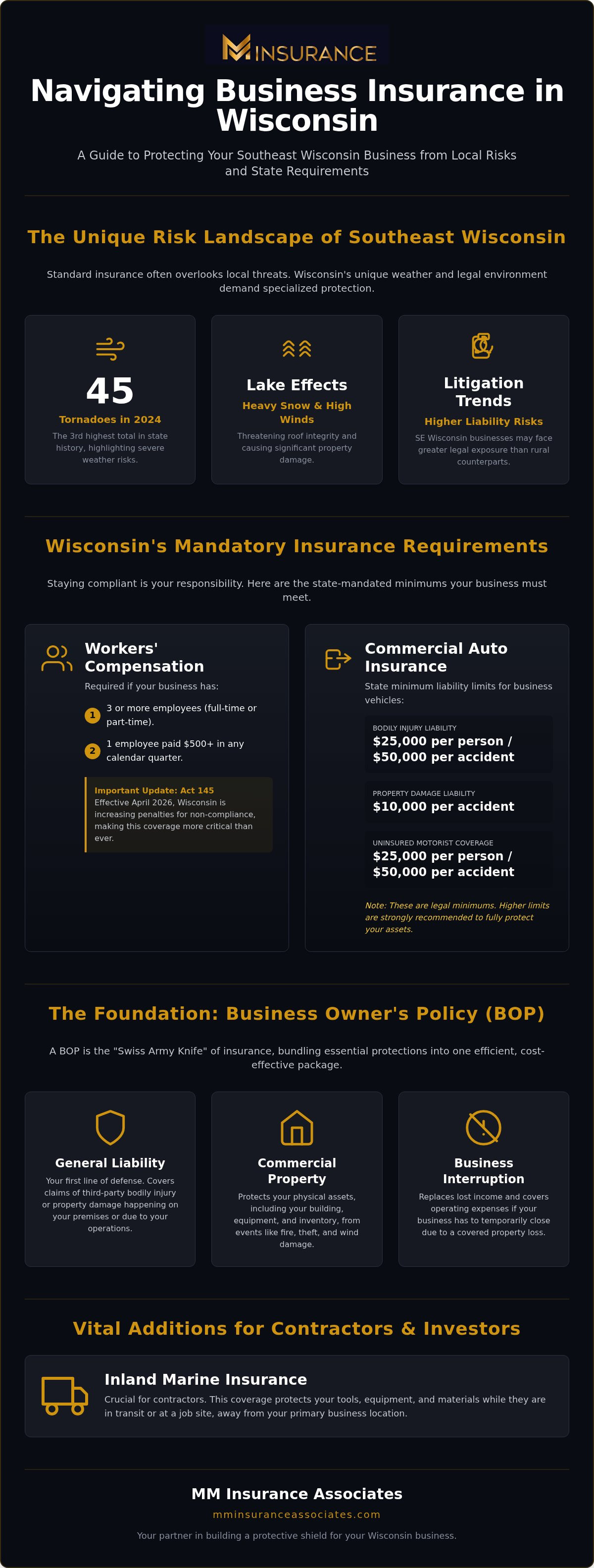
Did you know that Wisconsin recorded 45 tornadoes in 2024, the third-highest total in our state's history? For a small business owner in Southeast Wisconsin, that statistic is a sobering reminder that standard protection often isn't enough when local risks hit home. You've worked hard to build your company, and it's frustrating to feel like you're just another policy number lost in a national carrier's automated phone tree.
We understand that you want more than a generic document; you want the peace of mind that comes from knowing your specific trade is actually protected. This guide will help you secure the right local business insurance coverage by breaking down complex state requirements and the latest 2026 updates to Wisconsin workers' comp laws. We'll explore how a customized insurance portfolio, backed by a direct relationship with a local agent, acts as a protective shield for your assets. From mandatory liability limits for dwelling contractors to the nuances of Act 145, you'll discover exactly how to stay compliant while keeping your focus on growing your business.
Table of Contents
Understanding Local Business Insurance Requirements in Wisconsin
The Essential Components of a Wisconsin Business Owners Policy (BOP)
Independent Agency vs. Direct Writers: Why Local Brokerage Matters
Industry-Specific Coverage for Wisconsin Contractors and Real Estate Investors
Securing Your Quote: How to Evaluate Local Business Insurance Providers
Understanding Local Business Insurance Requirements in Wisconsin
Local business insurance coverage is more than a list of checkboxes; it is a protective shield for SE Wisconsin entrepreneurs designed to safeguard your hard work from local uncertainties. While national providers often offer generic plans, Wisconsin businesses face a unique regulatory and environmental landscape that requires a more precise touch. This customized approach ensures that your policy accounts for everything from specific state mandates to the unpredictable shifts in Lake Michigan weather patterns.
The Wisconsin Office of the Commissioner of Insurance (OCI) plays a vital role in this ecosystem by overseeing the industry and ensuring carriers remain solvent and fair. However, staying compliant is your responsibility. Many small business owners start their journey by securing a Business Owner's Policy (BOP), which bundles essential protections into one manageable package. Understanding these requirements is the first step toward building a resilient foundation for your company.
Mandatory vs. Recommended Coverage in WI
Wisconsin law is very specific about when certain coverages become mandatory. For instance, workers' compensation is required if you have three or more employees, or even just one employee if you pay them $500 or more in any calendar quarter. With the 2025 Wisconsin Act 145 taking effect in April 2026, the state has increased penalties for employers who operate without this coverage, making compliance more critical than ever.
If your business uses vehicles, you must meet the state's commercial auto insurance minimum liability limits. These currently include $25,000 for bodily injury per person, $50,000 per accident, and $10,000 for property damage. You also need uninsured motorist coverage of at least $25,000 per person and $50,000 per accident. While these are the legal minimums, local risks often necessitate higher limits to truly protect your assets.
The "Hidden" Risks of Southeast Wisconsin
Operating in New Berlin and the surrounding Milwaukee area brings specific environmental challenges. Our region is prone to heavy snow loads that can threaten roof integrity and Lake Michigan wind events that cause significant property damage. In fact, Wisconsin recorded 45 tornadoes in 2024, highlighting why property and business interruption insurance are essential rather than optional.
Beyond the weather, local litigation trends suggest that businesses in Southeast Wisconsin may face higher liability risks than those in more rural areas. If you're a contractor moving between job sites, "Inland Marine" insurance is a vital addition to your local business insurance coverage. It protects your tools and equipment while they are in transit, ensuring that a theft or accident on the road doesn't halt your operations.
The Essential Components of a Wisconsin Business Owners Policy (BOP)
A Business Owners Policy, or BOP, functions as the "Swiss Army Knife" of local business insurance coverage. It bundles several critical protections into one convenient package, offering a more efficient way to manage risk than buying individual policies. For entrepreneurs in New Berlin and surrounding areas, this structure provides a streamlined protective shield that covers liability, property, and lost income. It's a versatile solution that grows with you, whether you're running a boutique shop or a growing service firm.
According to Wisconsin's Guide to Insurance for Small Business Owners, a BOP is often the most cost-effective way for small firms to get the broad protection they need. It's designed for businesses that meet certain size and risk criteria, making it a favorite for local retail shops, offices, and small apartment complexes. By combining these coverages, you avoid the administrative headache of managing multiple renewal dates and separate carriers.
General Liability: Your First Line of Defense
Imagine a customer slips on an icy patch just inside your entryway during a January thaw. General liability is what steps in to handle the medical bills and potential legal fees. This coverage protects against third-party bodily injury and property damage claims that occur on your premises or because of your operations. It's the foundation of any professional insurance portfolio, ensuring that one accident doesn't wipe out your personal savings.
In the Milwaukee area, your liability limits should reflect the local economic environment. A standard $1 million limit might be sufficient for a quiet consulting office, but a high-traffic retail store in New Berlin might require more. You'll also need to choose between "occurrence" forms, which cover claims based on when the event happened, and "claims-made" forms, which depend on when the claim is filed. Most small businesses prefer occurrence forms for the long-term peace of mind they provide.
Protecting Your Physical Assets
Your physical assets are the lifeblood of your operation. A BOP distinguishes between the building itself and Business Personal Property (BPP), which includes your desks, computers, and inventory. For real estate investors managing multi-unit properties, building coverage is the priority. For a service-based business, BPP takes center stage, protecting the specialized tools you use every day.
When selecting coverage, you must decide between replacement cost and actual cash value (ACV). Replacement cost pays to replace your items with new ones of similar quality, while ACV factors in depreciation. In a state like Wisconsin where snow loads and freezing pipes are annual threats, having replacement cost coverage often provides much-needed stability. It ensures you can get back to work quickly without a massive out-of-pocket expense.
One often overlooked piece of the puzzle is business interruption insurance. If a winter storm causes a pipe to burst and forces you to close for two weeks, this coverage helps replace lost income and pay ongoing expenses like payroll. It's an essential safety net that keeps your dreams on track even when the doors are temporarily closed. If you're unsure which limits fit your specific industry, speaking with an experienced local agent can help you tailor these components to your exact needs.
Independent Agency vs. Direct Writers: Why Local Brokerage Matters
Choosing where you buy your policy is just as important as the protection itself. When you shop for local business insurance coverage, you'll likely encounter two different paths: the direct writer and the independent agent. Direct writers are insurance companies that sell only their own products through their own employees or websites. While this might seem simple, it often leads to a "Direct Writer Trap." If that specific carrier raises its rates or decides it no longer wants to cover your specific industry, you're left starting from scratch. You're locked into one set of rules and one price point, regardless of whether it still serves your business needs.
In contrast, an independent agency like MM Insurance Associates works for you, not the insurance company. We have the flexibility to shop dozens of carriers to find the right fit for your unique situation. This power of choice is essential because your business isn't static. As you grow, your risks shift, and having a partner who can pivot with you provides a level of security that a single-carrier employee simply can't offer. Even the SBA guide to business insurance suggests that comparing different options is a fundamental step in protecting your investment.
Evaluating the Independent Agent Model
The independent model gives you access to niche markets that national direct writers often avoid. Whether you're a contractor with specialized equipment or a real estate investor with a complex portfolio, we can tap into carriers that specialize in those exact risks. We also provide annual policy reviews. This isn't a "set it and forget it" service; we proactively look at your local business insurance coverage every year to ensure it still offers the best protection as market conditions in Southeast Wisconsin change. We act as a resourceful advocate, ensuring your portfolio remains both comprehensive and cost-effective.
Support Beyond the Policy
Claim time is when the value of a local advocate becomes truly clear. Instead of being funneled into a national call center, you have a direct line to a steady, experienced hand in Waukesha or Brookfield. We've been rooted in this community since 1997, which offers a level of stability and personal connection that an AI-driven startup or a distant institution can't match. We know the local landscape, we know the local adjusters, and we use that expertise to guide you through the complexities of a claim with confidence. This personal touch transforms a clinical industry into a dependable partnership where your stability is the top priority.
Industry-Specific Coverage for Wisconsin Contractors and Real Estate Investors
Generic policies often leave gaps that only become visible when a claim is denied. For tradespeople in Southeast Wisconsin, local business insurance coverage must be as specialized as the tools in your truck. A standard general liability policy might cover a trip-and-fall accident at your shop, but it often fails to address the unique risks inherent in construction and property management. Whether you're a plumber in Milwaukee or a real estate investor in West Allis, your protection needs to account for the specific work you perform and the locations where you operate.
Wisconsin Administrative Code SPS 305.31 requires dwelling contractors to demonstrate financial responsibility, which most meet through a general liability policy of at least $250,000 per occurrence. However, simply meeting the state minimum is rarely enough to protect a growing business. For electricians and plumbers, "completed operations" coverage is essential. This protects you if a wiring issue or a slow leak causes damage months after you've finished the job and moved on to the next site. Without this specific addition, a single faulty connection could lead to a devastating out-of-pocket expense.
Tailored Solutions for Skilled Trades
Your equipment is a significant investment that needs its own protective shield. While property insurance covers your shop, it often stops at the door. Inland marine insurance is the solution for local contractors on the move, protecting your expensive tools and materials while they are in transit to a job site in Oconomowoc or parked at a project in Waukesha. It's a practical way to ensure that a vehicle theft or a road accident doesn't paralyze your ability to work.
We also help small crews navigate the complexities of workers' compensation. As previously mentioned, Wisconsin's 2025 Act 145 has increased the stakes for compliance. We work with you to develop strategies that cover your employees and subcontractors correctly, ensuring you don't face the steep penalties associated with the new April 2026 regulations. For designers and consultants, we often recommend professional liability to protect against claims of errors or omissions in your plans.
Protecting Real Estate and High-Value Assets
Real estate investors face a different set of challenges, particularly when managing multi-unit properties in areas like Greenfield. Landlord insurance is designed to handle the specific liabilities of tenant-occupied spaces, while builder's risk is a must-have for house flippers and renovators. This coverage protects the structure itself during the vulnerable stages of construction when standard policies might exclude coverage for vacant buildings or active work zones.
For those with high-value assets, including high-value boat insurance for vessels on Lake Michigan or local inland lakes, an umbrella policy acts as the ultimate protective shield. It provides an extra layer of liability protection that kicks in after your primary limits are exhausted, which is vital for business owners with significant personal and professional investments to lose. If you're ready to move beyond "cookie-cutter" plans, you can request a customized contractor insurance quote that reflects the true scope of your trade.
Securing Your Quote: How to Evaluate Local Business Insurance Providers
While automated online tools promise a quote in minutes, speed often comes at the price of accuracy. For a business owner in Southeast Wisconsin, a generic estimate might miss the specific nuances of your trade or the local risks we've discussed. Securing the right local business insurance coverage requires a methodical approach that prioritizes precision over haste. By working with a local expert, you ensure that your policy is built on actual data rather than broad assumptions.
Asking the right questions is just as important as the data you provide. Instead of focusing solely on the annual premium, inquire about how the carrier handles claims in the Milwaukee area. Ask about specific exclusions that could impact your trade, such as height restrictions for contractors or vacancy clauses for real estate investors. Comparing quotes "apples to apples" means looking past the price tag to ensure the limits, deductibles, and endorsements are truly equivalent across different options.
The Quote Checklist
To provide you with a comprehensive protective shield, a local agent needs a clear picture of your operations. Preparing these details in advance will streamline the process and lead to a more accurate result. Having this information ready allows us to advocate for you more effectively with various carriers:
Financial Data: You'll need accurate payroll estimates, projected gross sales, and current property values for your buildings and equipment.
Operational Details: Be ready to share a summary of your safety protocols and any previous claims history from the last three to five years.
Current Policies: Providing your existing declarations pages helps us identify "gaps" in your current local business insurance coverage before they become financial crises.
Next Steps with MM Insurance Associates
Our New Berlin-based team begins every consultation by listening. We don't just plug numbers into a spreadsheet; we work to understand the specific goals you have for your Wisconsin business. Whether you're a plumber looking to expand your crew or a real estate investor growing a portfolio in Waukesha, we act as a steady, experienced hand to guide you through the marketplace.
The timeline for securing coverage is typically efficient, but we take the time necessary to ensure every detail is correct. We shop dozens of carriers on your behalf, presenting you with a range of choices that balance protection and value. Once you've selected the right path, we help you finalize your "Safety Harbor," moving you from a simple quote to active, reliable protection. You can request a personalized local business insurance review today to start the conversation with our team.
Building Your Protective Shield for 2026 and Beyond
You've seen that standard policies often fall short of meeting Wisconsin's specific legal and environmental demands. Whether you're navigating the updated workers' comp penalties of Act 145 or protecting specialized tools on the road, local business insurance coverage works best when it's tailored to your unique risks. Choosing an independent advocate over a distant, direct writer ensures that your policy remains flexible as your company grows and market conditions shift.
Since 1997, MM Insurance Associates has served as a resourceful guide for entrepreneurs across Southeast Wisconsin. As an independent agency, we prioritize your stability by offering choices from top-rated carriers rather than locking you into a single, limited option. Our specialized expertise in contractor and real estate insurance ensures that your high-value assets are always protected by a steady, experienced hand. You've worked hard to build your legacy; we're here to help you defend it.
Don't leave your future to chance or an automated call center. Secure Your Business with a Local Expert Quote today. We look forward to providing the peace of mind you deserve so you can stay focused on what you do best.
Frequently Asked Questions
Is business insurance required by law in Wisconsin?
Business insurance is legally required for most Wisconsin employers, specifically regarding workers' compensation and commercial auto liability. If you have three or more employees, or even one employee paid $500 or more in a quarter, workers' comp is mandatory. Additionally, any business-owned vehicles must meet the state's minimum liability limits. While other coverages like general liability aren't always mandated by law, they are often required by contracts with landlords or clients.
How much does local business insurance cost in the Milwaukee area?
The cost of local business insurance coverage depends on several factors including your industry, annual revenue, and total payroll. Every business in the Milwaukee area has a unique risk profile, so a plumber in New Berlin will have different premium needs than a real estate investor in Waukesha. Instead of looking for a generic price, it's more effective to have an agent shop multiple carriers to find a rate that fits your specific budget.
What is the difference between General Liability and a Business Owners Policy?
General liability is a single layer of protection that covers third-party bodily injury and property damage. A Business Owners Policy (BOP) is a more comprehensive bundle that includes general liability along with property insurance and business interruption coverage. For most small businesses, a BOP acts as a more versatile protective shield, often providing broader coverage at a lower total cost than purchasing each policy separately.
Do I need separate insurance for my tools and equipment if I am a contractor?
Standard property insurance usually only covers items while they are at your primary business location. As a contractor, your tools and equipment are constantly moving between job sites, which is why you need inland marine insurance. This specific coverage follows your gear wherever it goes in Southeast Wisconsin, ensuring that theft or damage on the road or at a client's property doesn't result in a total loss for your business.
Can an independent agent really find better rates than a national carrier?
Independent agents have the freedom to compare policies from dozens of different insurance companies, whereas national direct writers can only offer their own brand's products. This ability to shop the market allows an independent agent to find more competitive rates and niche coverages that a single carrier might not provide. We work for you, not the insurance company, which gives us the flexibility to prioritize your stability and savings.
Does my homeowners insurance cover my home-based business in New Berlin?
Homeowners policies are designed for personal risks and typically provide very little protection for business-related activities. Most exclude professional liability and have very low limits for business property, such as computers or specialized inventory. If you run a business out of your New Berlin home, you likely need a specific business policy or an endorsement to ensure your professional assets and liabilities are fully covered against common risks.
This guide covers the fundamentals every small business owner should know. For a deeper look at specific coverage types and limits, our Business Insurance page breaks down general liability, property, and business owner policies in more detail.
What happens if I have an employee but no workers compensation insurance in WI?
Operating without required workers' compensation insurance in Wisconsin can lead to severe financial penalties and legal action. Under the 2025 Wisconsin Act 145, the state has increased scrutiny and penalties for non-compliance. Beyond government fines, you would be responsible for paying all medical expenses and lost wages out of pocket if an employee is injured. This can lead to a financial crisis that threatens the existence of your company.
How often should I review my business insurance coverage?
You should conduct a thorough review of your local business insurance coverage at least once a year during your renewal period. It's also vital to update your agent whenever your business experiences significant changes, such as hiring more staff, purchasing high-value equipment, or moving to a new office. Regular check-ins ensure that your protective shield remains strong and that you aren't paying for coverage you no longer need as your operations evolve.

Comments