

.png)
.png)


Wisconsin Startup Insurance: 2026 Founder's Guide

Updated: Aug 22
What if the very thing you're viewing as a monthly expense is actually the secret to landing your first major enterprise contract? For many founders, securing business insurance for startups Wisconsin feels like a complex legal hurdle that eats into slim pre-revenue margins. It's completely normal to feel overwhelmed by the conflicting advice regarding state requirements versus federal guidelines, especially when you're worried about personal liability or high premiums. You want to focus on building your product, but the fear of a single lawsuit wiping out your hard work is a heavy burden to carry.
We believe that insurance shouldn't be a source of stress, but a protective shield that gives you the confidence to take bold risks. This guide will help you master the essentials of protecting your new venture with a clear roadmap that moves from basic legal requirements to scalable coverage. You'll find a practical checklist of must-have versus nice-to-have policies and learn how to adjust your protection as your team expands. We'll also explore why finding a local partner who understands our unique Wisconsin market is the smartest way to keep your business stable and secure as you grow.
Table of Contents
Understanding the Core: Why Startups Need Business Insurance
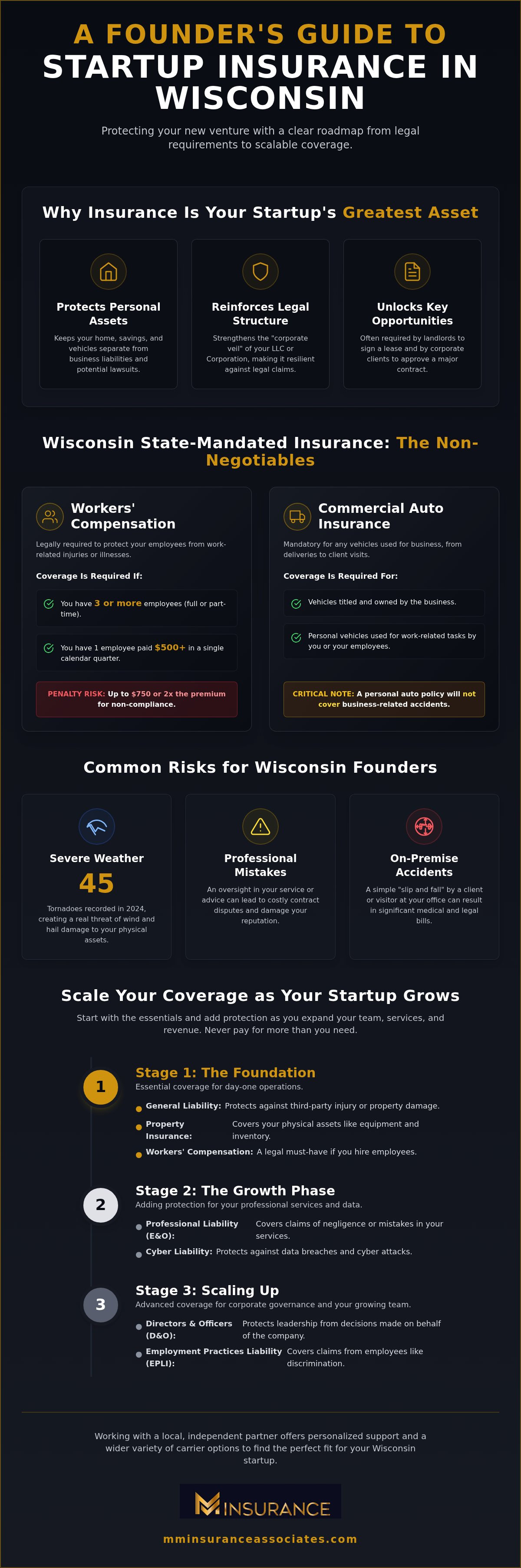
Think of business insurance as a protective layer that sits firmly between your professional risks and your personal assets. When you're in the early stages of building a company, it's easy to view coverage as just another line item on a spreadsheet. However, it's actually the financial foundation that allows you to operate with confidence. For many founders, reviewing a business insurance overview is the first step toward legitimizing their vision. It transforms your venture from a passion project into a resilient entity that's prepared for the unexpected.
If you've registered your business as an LLC or a Corporation, you've already taken steps to create a "corporate veil." This legal boundary is designed to separate your personal savings, home, and vehicles from the debts and liabilities of your company. But this veil isn't invincible. Without proper business insurance for startups Wisconsin, a significant legal claim could potentially lead a court to "pierce the veil," leaving your personal finances vulnerable. Insurance reinforces your legal structure, providing the financial weight necessary to satisfy claims without touching your family's future.
Beyond legal protection, there's a practical side to getting covered early. Most Wisconsin landlords won't sign a lease for office or retail space without seeing a Certificate of Insurance. Similarly, many corporate clients in the Milwaukee area require proof of coverage before they'll even consider a partnership. Having your policies in place means you're always ready to say "yes" to a new opportunity or a strategic lease agreement.
The Difference Between Personal and Business Liability
It's a common misconception that personal home or auto policies will provide a safety net for your startup activities. They won't. Imagine you're running a tech consultancy from your home office in Brookfield. If a client visits to discuss a project, trips on a rug, and sustains an injury, your home insurance will likely deny the claim because the activity was business-related. A dedicated business policy provides a clean break for both legal and tax purposes. It ensures that your professional world and personal life stay separate, which is essential for accurate bookkeeping and long-term stability.
Common Risks for Wisconsin Founders
Entrepreneurs in the Badger State face a unique set of challenges that require specific attention. Our weather is a primary concern. With Wisconsin recording 45 tornadoes in 2024, wind and hail damage are very real threats to physical equipment and inventory. Beyond the elements, you must consider human error. Whether it's a slip-and-fall during a meeting or a professional mistake that leads to a contract dispute, these risks are part of doing business. Securing business insurance for startups Wisconsin early on allows you to shift these burdens to a partner, giving you the peace of mind to focus entirely on scaling your brand.
Wisconsin State Requirements: What Your Startup Must Have by Law
While the first part of our guide focused on why you should have protection, this section covers what the state says you must have. Staying compliant isn't just about following rules; it's about avoiding the heavy penalties that can derail a new business before it truly starts. With over 560,000 small businesses operating in our state, Wisconsin has clear guidelines to ensure both founders and employees are protected. Understanding the specific legal landscape for business insurance for startups Wisconsin is the first step toward long-term stability.
The Wisconsin Workers' Comp Rule
In our state, the requirement for workers' compensation is broader than many founders realize. You are legally required to carry this coverage if you have three or more employees, or even just one employee who is paid $500 or more in any calendar quarter. If you hit that $500 mark, you must have a policy in place by the 10th day of the first month of the following quarter. Failing to do so can lead to a penalty of $750 or twice the unpaid premium, whichever is higher.
Reviewing Wisconsin worker's compensation laws is vital for anyone hiring their first team member in New Berlin or Milwaukee. The Wisconsin Compensation Rating Bureau (WCRB) oversees these rates and classifications. While sole proprietors are generally exempt, many choose to opt in anyway. This provides a safety net for medical bills if you're injured on the job, which is a smart move for founders who don't have robust personal health coverage yet.
Commercial Auto vs. Hired and Non-Owned Auto
If your startup uses vehicles for business on Wisconsin highways, state law mandates specific liability minimums. You'll need at least $25,000 for bodily injury per person, $50,000 per accident, and $10,000 for property damage. However, many founders make the mistake of using a personal vehicle for deliveries or client visits in Waukesha without a commercial rider. Most personal policies have "delivery" or "rideshare" exclusions. This means a claim could be denied entirely if you're in an accident while working.
For startups that don't own a fleet but have employees driving their own cars for work tasks, "Hired and Non-Owned Auto" coverage is essential. It protects the business if an employee causes an accident while running a work errand. It's a cost-effective way to manage business insurance for startups Wisconsin without the high cost of a full commercial fleet policy. If you want to ensure your team is fully protected while on the road, it's a good idea to explore customized business insurance options with a local expert.
Beyond these requirements, you'll also need to manage Unemployment Insurance and potentially local municipal permits. For instance, specific trades in Milwaukee may require bonds or registration with the Department of Safety and Professional Services (DSPS) before you can begin operations. Taking the time to verify these details now prevents costly interruptions later.
Choosing the Right Policy Based on Your Startup’s Industry
Once you've met the state's legal requirements, the next step is building a protection plan that fits your specific daily operations. While the law tells you what's mandatory, your industry dictates what's actually necessary to keep your doors open. Selecting the right business insurance for startups Wisconsin isn't about buying every policy available; it's about identifying the specific vulnerabilities of your niche. Whether you're launching a tech firm in Milwaukee or a retail shop in Pewaukee, your risks are unique, and your coverage should reflect that.
General Liability insurance serves as the bedrock for almost every new venture. It protects you against "slip and fall" accidents and third-party property damage. Even if you run a service-based business with no physical storefront, this policy is often required by clients before you can sign a contract. For those in the professional services sector, such as consultants, accountants, or software developers, Professional Liability (also known as Errors and Omissions) is equally vital. It shields you if a client claims your advice or a technical error caused them financial loss. To better understand how these different layers work together, you can consult the SBA guide to business insurance for a foundational overview of risk assessment.
Cyber Liability is another essential consideration that many local founders overlook. You don't need to be a global tech giant to be a target for data breaches. If you store customer emails, credit card info, or sensitive project data in a home office in Pewaukee, you have a digital footprint that needs protection. This coverage helps manage the costs of notifying customers and recovering data after a security incident.
Trade-Specific Protection: Contractors, Plumbers, and Electricians
For those in the construction and trade industries, standard liability often isn't enough. If you're a plumber or electrician working on a new build in New Berlin, you need "Completed Operations" coverage. This protects you if a pipe bursts or a circuit fails months after you've finished the job. Additionally, consider Inland Marine insurance. Despite the name, it has nothing to do with water; it's designed to protect your expensive tools and equipment while they're in transit between job sites in West Allis or stored in a trailer overnight.
The Business Owner’s Policy (BOP): The Startup’s Best Friend
The Business Owner’s Policy is frequently the most efficient way to secure business insurance for startups Wisconsin. A BOP bundles General Liability and Property insurance into a single package, usually at a lower premium than purchasing them separately. It's designed for small to mid-sized businesses with lower risk profiles, such as local boutiques or office-based startups. If your revenue and employee count fall within certain limits, a BOP provides a comprehensive shield that simplifies your paperwork and stabilizes your monthly budget.
Managing Costs: How to Scale Your Coverage as You Grow
Managing the budget for business insurance for startups Wisconsin shouldn't feel like a guessing game. Many founders make the mistake of buying "Enterprise-level" coverage for what is currently a "Garage-level" startup. While you want to be protected, you don't need to pay for risks you haven't encountered yet. Instead, think of your insurance as a scalable resource that grows alongside your revenue and headcount. This approach ensures you're never underinsured during a growth spurt, but you're also not wasting precious capital on unnecessary premiums.
Adjusting your deductible is one of the most immediate ways to control your monthly costs. A higher deductible typically results in lower premiums. This can be a smart strategy for a startup that is cash-flow conscious but has enough of a reserve to cover a minor out-of-pocket loss. It's a balance of risk and reward that you can adjust as your financial stability improves. Additionally, implementing simple safety protocols and using solid legal contracts can signal to carriers that you're a lower risk, which often leads to more favorable pricing over time.
Factors That Influence Your Wisconsin Premiums
Your specific ZIP code in the Greater Milwaukee area plays a significant role in your property insurance rates. Costs in downtown Milwaukee might differ from those in a New Berlin business park based on local risk data and historical claims in the area. Your claims history, or lack thereof, is also a major factor. Keeping a clean record by prioritizing safety is the best way to keep long-term costs down. Finally, accurate payroll estimates are crucial. Since the state requires Workers' Comp once you pay an employee $500 in a single quarter, being precise with your numbers helps you avoid "audit shock" at the end of the policy year.
Scaling Milestones: When to Add More Protection
Timing is everything when expanding your protective shield. We recommend reviewing your coverage at three specific milestones:
Milestone 1: Hiring your first employee. This is the legal trigger for Workers' Comp and often the point where you should consider employment practices liability.
Milestone 2: Signing your first commercial lease. Your landlord will almost certainly require specific Property and General Liability limits before handing over the keys.
Milestone 3: Reaching $1M in annual revenue. At this stage, your exposure increases significantly, making an Excess Liability or Umbrella policy a wise addition to protect your growing assets.
To ensure your coverage matches your current stage of growth without overstretching your budget, request a customized insurance review from our local team today. We'll help you find the right balance of protection and price for your unique journey.
Why a Local Independent Agent is a Startup’s Best Asset
Choosing business insurance for startups Wisconsin shouldn't be a lonely process conducted on a generic national website. While those platforms offer speed, they often lack the personalized advocacy you need when a real crisis hits. An independent agent works for you, not a single insurance carrier. This distinction is vital because it gives you the power of choice. Instead of being forced into a one-size-fits-all policy, you gain access to a variety of carriers that compete for your business, ensuring you get the most comprehensive protection for your budget.
Local knowledge is another factor that national algorithms simply can't replicate. Understanding the specific environmental risks of Southeast Wisconsin, from lake-effect snow to the recent uptick in tornado activity, allows a local agent to build a more resilient shield for your property. Whether you're operating out of a tech hub in Milwaukee or a warehouse in Waukesha, we understand the local dynamics and legal requirements that affect your daily operations. This regional expertise transforms insurance from a distant bill into a practical tool for stability.
The Broker Advantage: Shopping the Market for You
At MM Insurance Associates, we've spent over 25 years serving the New Berlin and Greater Milwaukee community. Since 1997, our independent model has allowed us to shop the market on behalf of our clients, finding the "sweet spot" where robust protection meets competitive pricing. We help you avoid the "cookie-cutter" trap that many founders fall into when using big national websites. Those sites often overlook the nuances of your specific trade, but we take the time to understand your unique risks, whether you're a consultant or a specialized contractor.
We also offer the advantage of being a one-stop shop. As your startup grows, your personal needs often change alongside your professional ones. We can manage your business, home, auto, and life insurance in one place. This holistic view ensures there are no gaps in your coverage and that your personal assets remain as protected as your business ventures.
Building a Long-Term Partnership
The first few years of a startup are notoriously volatile. Having a steady, experienced hand to guide you through scaling milestones is invaluable. We don't just sell you a policy and disappear; we act as a long-term consultant. When you hire that first employee or sign a new lease, we're here to adjust your coverage and ensure you remain compliant with state laws. We pride ourselves on being a dependable partner that provides peace of mind, allowing you to focus on the growth and innovation that will define your company's future.
Protect your startup today-get a customized quote from MM Insurance Associates and see how a local expert can make the difference in your business journey.
Building Your Legacy on a Solid Foundation
Your startup is more than just a business; it's the result of your hard work and vision. Protecting that vision requires a proactive approach to risk management that evolves as you grow. We've explored how a tailored strategy helps you navigate state mandates while shielding your personal assets from professional liabilities. By understanding the specific triggers for workers' compensation and the benefits of industry-specific policies, you're already ahead of the curve. Securing the right business insurance for startups Wisconsin is the final piece of the puzzle that allows you to pursue new contracts and leases with complete confidence.
At MM Insurance Associates, we've served as local New Berlin experts since 1997. Our independent agency model means we shop through a wide network of carriers to find the perfect fit for your unique needs. Whether you're a specialized contractor or a growing tech firm, we prioritize your stability and peace of mind. We invite you to Secure Your Startup’s Future with MM Insurance Associates and experience the relief of having a dedicated partner by your side. You have an incredible journey ahead; we're here to ensure you have the steady support needed to reach every milestone.
Frequently Asked Questions
Do I need business insurance if I run my startup from home in Wisconsin?
Yes, you generally need a separate policy because standard Wisconsin home insurance policies rarely cover professional liabilities or specialized business equipment. If a client visits your home office and sustains an injury, or if a power surge destroys your professional inventory, your personal policy will likely deny the claim. A dedicated business policy ensures your startup is protected without risking your personal coverage standing or your family's assets.
How much does a basic business insurance policy cost for a startup in WI?
The cost of business insurance for startups Wisconsin varies based on your industry, revenue, and location. Your specific premium will depend on your unique risk profile and the coverage limits you choose to carry. Factors like your ZIP code in the Milwaukee area and the total number of employees you have will influence the final rate. An independent agent can help you compare multiple carriers to find the most competitive pricing for your current stage of growth.
Is General Liability insurance required by law in Wisconsin?
General Liability is not mandated by Wisconsin state law for most businesses, but it is almost always required by landlords and clients. You'll find that most commercial lease agreements in New Berlin or Milwaukee require proof of this coverage before you can move in. Even if it isn't a legal requirement, it serves as a critical protective layer against common accidents, property damage, and the high costs of legal defense.
What is the difference between General Liability and Professional Liability?
General Liability covers physical risks like bodily injury or property damage, while Professional Liability covers financial losses caused by your work or advice. If someone trips at your office, that's a General Liability claim. If a client sues because a technical error in your software or a mistake in your consulting caused them a financial loss, that's Professional Liability. Having both ensures you're protected from both physical and intellectual risks.
When should a Wisconsin startup buy Workers' Compensation insurance?
You must obtain Workers' Compensation insurance as soon as you have three or more employees or pay at least $500 in wages in a single calendar quarter. This is a strict Wisconsin requirement that applies to almost every business once they hit those thresholds. You must have the policy active by the 10th day of the month following that quarter. It's a vital safety net that protects both your team and your company's long-term financial stability.
Startups have their own risk profile, but the core coverage categories are the same ones every Wisconsin business needs. Our Business Insurance page walks through those coverages in full.
Can I use my personal auto insurance for my business vehicle?
You cannot rely on personal auto insurance for vehicles used primarily for business tasks or deliveries. Most personal policies in Wisconsin specifically exclude coverage for professional errands or delivery services. If you're involved in an accident while working, your claim could be denied entirely. You'll need a commercial auto policy or a specific business use endorsement to ensure you're fully protected while on the road for work.
What is a Business Owner's Policy (BOP) and does my startup qualify?
A Business Owner's Policy is a bundled package that combines general liability and commercial property insurance into one affordable premium. Most small to mid-sized startups in low-risk industries qualify for this type of coverage. It's a popular choice for new founders because it simplifies your insurance paperwork and provides a broad shield against the most common professional risks you'll face during your first few years of operation.
How do I get an insurance certificate for a new client or landlord?
You can obtain a Certificate of Insurance by simply contacting your insurance agent and providing the details of the party requesting it. Your agent will issue a document that proves your coverage limits and policy dates. This is a routine request when signing new contracts or leases in the Milwaukee area. Having a local partner like MM Insurance Associates makes this process quick and seamless, allowing you to stay focused on your business.
Comments